
Uncategorized
5 Holiday Ideas Your Senior Dog Will Actually Love (And One to Avoid)
May
There’s something quietly heartbreaking about packing a suitcase and watching your old dog watch you do it. They’ve worked out what those zips mean. Maybe in younger years they’d have been bouncing off the walls — now there’s just a slow thump of the tail and a long, considered look that says please don’t leave me behind this time.
Here’s the good news: you don’t have to. Senior dogs make some of the best holiday companions in the world. They’re calm in the car, they’re not interested in chasing every seagull on the beach, and they tend to sleep through the bits where you’d really rather they did. The trick is choosing the right kind of holiday — one that plays to their strengths instead of testing their limits.
These five ideas all work. We’ve put them in order from gentlest to most adventurous, so you can pick the one that suits your dog as they are today, not as they were five years ago.
1. A cosy cottage in the British countryside
If you’re going to do one holiday with your senior dog this year, make it this one. Dog-friendly cottages are everywhere now — the Lake District, the Yorkshire Dales, Northumberland, North Wales, Devon and Cornwall, the Scottish Highlands. Most are kitted out with stone floors that wipe clean after muddy paws, wood burners for the evening, and enclosed gardens where an older dog can potter at their own pace without a lead.
What makes a cottage so brilliant for an older dog is the rhythm of it. They get their own corner, their own bed, their own bowl in the same place every morning. They have a quiet base they can return to between gentle walks, naps in a sunbeam, and an evening of you reading on the sofa with their head on your foot.
Look for somewhere with single-storey access or minimal stairs, a secure garden so they can toilet at their own pace, and ideally a wood-burning stove — older dogs feel the cold more, and there’s nothing they love more than slowly cooking themselves in front of a fire.
2. Glamping (the comfortable kind)
Glamping has come a long way from “tent with a slightly nicer mattress.” Shepherd’s huts with underfloor heating, yurts with proper beds and log burners, cabins with hot tubs and full kitchens — it’s camping for people who like sleeping properly, and it’s increasingly brilliant for senior dogs too.
The benefit over a regular cottage is the nature on your doorstep. Your dog wakes up to woodland or hill views, the air smells of pine or sea, and they can wander out to do their morning sniff-tour straight from the door.
A few things to look for when booking:
- Heating, not just bedding — older dogs really do struggle in the cold
- A flat or step-free entrance (those cute shepherd’s hut steps are not your friend)
- Calm surroundings — avoid sites with lots of barking dogs or a busy bar nearby
- A fenced area if possible, so your dog can potter without being constantly tethered
Sites like Meon Springs in Hampshire, Brook House Woods in Herefordshire, and Loose Reins in Dorset are well-regarded with dog owners, but the UK is full of independent farms doing brilliantly thoughtful pet-friendly setups now.
3. A coastal break (where your dog can paddle, not swim)
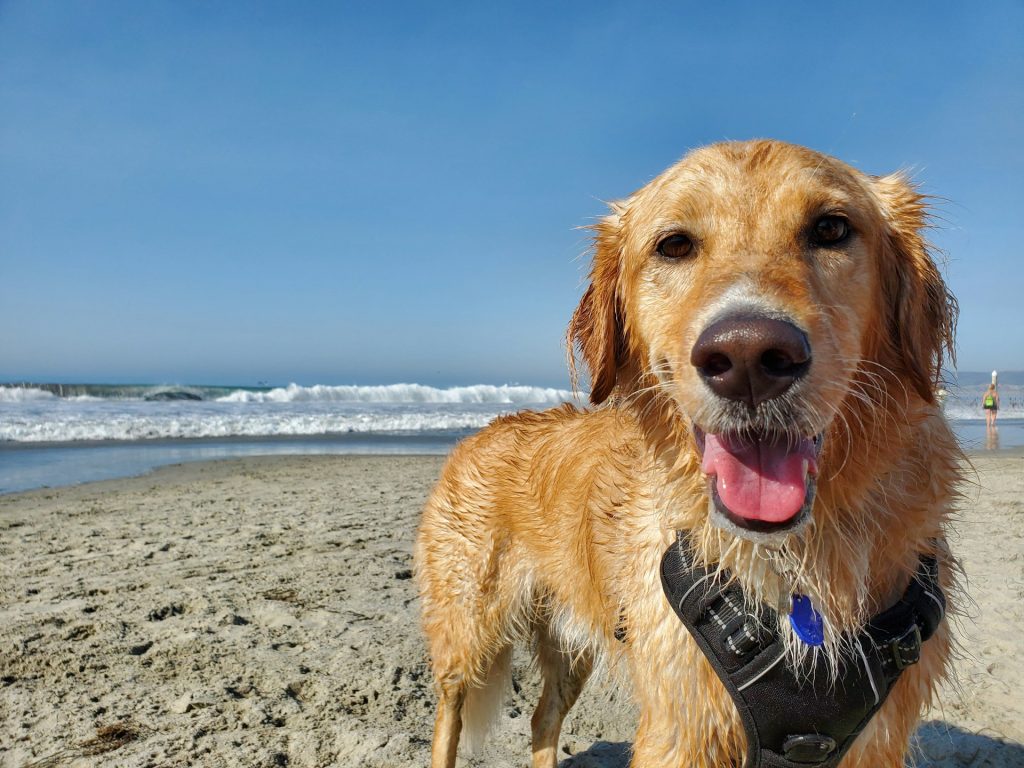
Older dogs and the British seaside are a beautiful combination. The sand is soft on tired joints. The water is bracing in the best way. And the kind of beach walk a senior dog enjoys — slow, sniffy, with plenty of pauses to look at things — is exactly the kind of walk most beaches encourage.
A word of caution: don’t assume your dog still swims like they used to. Joint stiffness, reduced muscle mass, and slower reactions all add up to a dog that tires faster in water than they realise. Even confident swimmers can get into trouble in their later years. A canine buoyancy aid — Ruffwear’s Float Coat is the gold standard, but there are cheaper good options too — is one of the best £40 you’ll ever spend on a senior dog holiday.
Stick to calm bays and estuaries rather than open sea, avoid windy days and strong tides, and keep walks to early morning or evening in warm weather. Many UK beaches have seasonal dog bans between May and September — always check before you go. Northumberland, North Norfolk, Pembrokeshire and the north Cornish coast all have year-round dog-friendly stretches.
4. A canal boat holiday
This one’s a bit left-field, but hear us out: canal boats are made for senior dogs.
The pace is gentle (around 4mph — you couldn’t rush if you tried). Your dog is never more than a few feet from you. There’s a constant, low-stimulation slideshow of ducks, swans and waving walkers going past the window. And when you moor up for the night, there’s almost always a towpath walk straight off the boat — no driving anywhere, no lead-tugging, no unfamiliar pavements.
Look for a wider beam boat if your dog struggles with balance, and one with a low side step for getting on and off. Most hire companies will fit a removable ramp on request. The Llangollen Canal, the Kennet & Avon, and the Caledonian Canal all make for stunning slow holidays.
5. A gentle road trip
If your dog still has the energy and you have a comfortable car, a road trip is a wonderful way to give them a final big adventure — or a brilliant first one if they’ve never really been beyond the local park.
The key word is gentle. Plan two to three hours of driving per day, no more. Build in a proper stop every 90 minutes for a stretch, a sniff and a drink. Choose two or three bases rather than a different bed every night — older dogs find constant new environments stressful, even when the new environments are lovely. And bring familiar things: their own bed, their own bowl, a blanket that smells of home.
A North Coast 500 trip done at half-speed, a slow loop through the Cotswolds, a meandering drive down the Welsh coast — all of these can be the kind of holiday your dog tells everyone about (in their own way) for the rest of their life.
And the one to avoid: cycling holidays with your dog in a trailer
You’ll see this suggested a lot online. We’d gently push back. Pulling a senior dog along in a bike trailer puts them in an unfamiliar, vibrating environment for hours at a time, often in the cold or wind, with nothing for them to do and no way for them to signal discomfort beyond panting or whining. Most older dogs find it stressful rather than fun. There are much better ways to give them new sights and sounds.
Before you go: a quick senior-dog packing list
- Their own bed (familiar smell = better sleep = less stiffness in the morning)
- A non-slip mat for slippery cottage floors
- Their food, measured out — sudden diet changes plus travel often equals upset stomachs
- A copy of their vet records and the number of a vet near where you’re staying
- Plenty of fresh water and a portable bowl
- Their joint supplement — don’t skip days while you’re away
- A towel (or three)
- Any medication, plus a couple of spare days’ worth
One last thing
The holidays your senior dog will remember aren’t the busiest ones. They’re the ones where they got to be near you, in interesting smells, at their own pace, with somewhere warm to sleep at the end of it. Every dog deserves a few of those before the end.
If your older dog finds long walks harder than they used to — stiffness in the morning, slowing down on the second lap of the park, a hesitation at the bottom of the stairs — it’s worth getting their joints properly supported before you head off. Our Senior Max Plus is our highest-strength joint supplement, made in the UK with glucosamine, chondroitin, turmeric and Omega-3, and it’s the difference between an older dog who manages a holiday and one who genuinely enjoys it.
Have a wonderful trip. Give them a treat from us.
